 LotsBlog
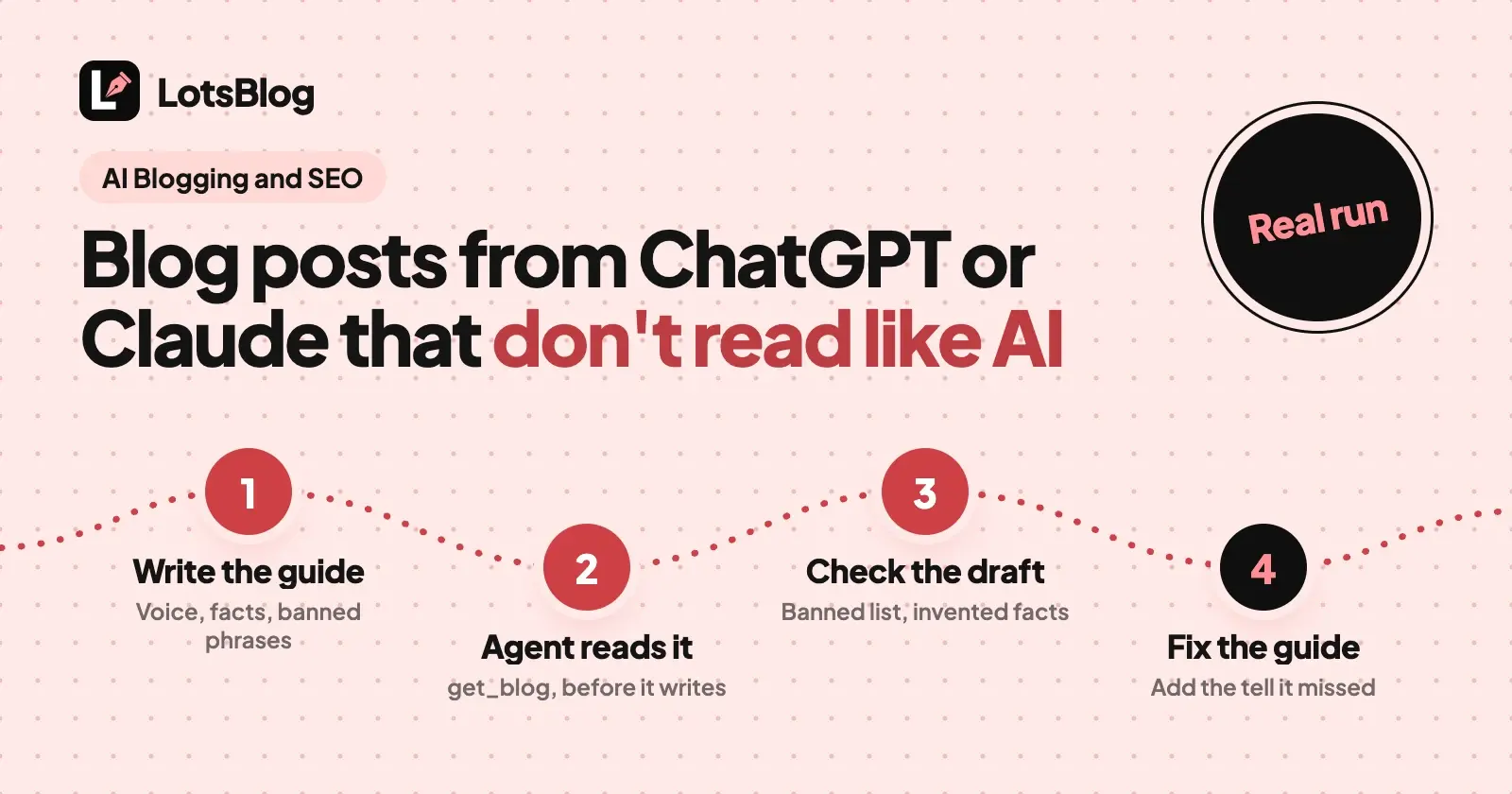
Give your agent a short private style guide before it writes: who reads the blog, the facts it may use, how you sound, and a list of phrases it must never use. Then check every draft against that list. In a run on 27 October 2026, the same agent wrote the same post twice. Without a guide it used all 13 banned phrases I later listed. With the guide it used none, and it came out 24 words shorter.
This page shows the run step by step, with the real tool output, plus the guide template I used so you can copy it.
What makes a post read like AI?
It's rarely one thing. A model with no instructions writes for nobody in particular, so you get the same tells every time:
- An opening about "today's fast-paced world" that says nothing.
- Words nobody says out loud: delve, seamless, unlock, elevate, leverage.
- "Not only X but also Y" sentences, and a closing "In conclusion" with a call to action.
- Three bullet points where a paragraph with one real number would do.
- No specific fact anywhere, because the model has none to use.
The fix is to hand the agent the specifics once, in a place it reads every time, instead of retyping them into each chat.
The workflow in four steps
- Write a private style guide: audience, facts, voice rules, banned phrases, and one "never".
- Store it where your agent reads it before writing. In LotsBlog that is the blog guide, private Markdown in Settings, Blog guide (or
update_blogfrom your agent). - Have the agent read the guide, write the post, and save it as a private draft.
- Check the draft against your banned list and your facts. When something slips through, add it to the guide.
LotsBlog doesn't write the post or enforce the guide. Your agent writes, and it follows the guide because it reads it. Step 4 is yours.
I ran it: the same post, with and without a guide
I used a fictional business so nothing here could be mistaken for a real one: Example Loaf Bakery, a neighbourhood bakery that gives 25 cents off when a customer brings back a cloth bread bag. I ran everything from Claude Code through the LotsBlog MCP, on a private test blog I created for this. Nothing was published, and both drafts are in Trash.
1. A private blog, with no guide yet. create_blog with privacy: private returned (shortened):
{"success":true,"blog":{"id":"a20e4dcc-...","privacy":"private", ... },"message":"Blog created successfully"}
get_blog on it shows an empty guide: "blog_guide":"".
2. First draft, no guide. I asked for a post on why a small bakery should use reusable bread bags and saved it with create_blog_post. The result came back with "status":"draft" and "is_published":false. This is what the agent wrote:
In today's fast-paced world, sustainability is more important than ever. Whether you're a small bakery or a large chain, it's crucial to rethink your packaging. In this article, we'll delve into the key benefits of reusable bread bags...
Reusable bags are a game-changer for modern bakeries. They not only reduce waste but also foster customer loyalty, creating a seamless and meaningful experience.
Every sentence could sit on any bakery's blog. It names no loaf, no price and no day of the week. The closing section is headed "Conclusion" and ends "Ready to take the next step? Start today!"
3. Write the guide from what the draft got wrong. I read the draft, wrote down the tells, and saved this guide with update_blog (shortened here; the full text is in the template below):
## Voice rules
- Short sentences. Mix them with an occasional long one. Contractions are fine.
- One concrete detail per paragraph: a number, a day, a smell, a price.
- Name the loaf (sourdough, seeded rye), never "baked goods".
- No "Conclusion" heading.
## Banned words and phrases
delve, game-changer, seamless, unlock, elevate, leverage, navigating, in today's
fast-paced world, it's crucial, not just X but Y, in conclusion, ready to take the
next step, powerful way.
## Never
Invent customers, quotes or statistics. If a fact is not in the list above, ask me.
The tool answered "message":"Blog updated successfully". Then get_blog returned the whole guide in the blog_guide field, which is how an agent in a fresh session picks it up. The guide also holds the only facts the agent may use: 40 loaves a day, six days a week, closed Mondays, a 3 dollar bag, 25 cents off per return.
4. Second draft, with the guide. Same topic, same agent, after reading the guide:
Bring a cloth bread bag back to us and we take 25 cents off your loaf, every time. The bag costs 3 dollars, so it has paid for itself after twelve loaves.
How does the bag work?
You buy it once at the counter. Next time you come in for sourdough or seeded rye, hand it over and we slide the loaf straight in. No paper, no plastic, no fuss.
The first two sentences answer the question. The headings are things a neighbour would ask. The arithmetic is checkable: 3 dollars divided by 25 cents is twelve.
5. Check the draft: it still broke a rule. My first version of this second draft also said the bakery started the bags because "most of them left the shop in paper that went in the bin by lunchtime", and that Tuesday morning is when the shelves are fullest. Neither is in the guide's fact list. I had made them up to sound specific, which is exactly what the "Never" line forbids. I caught it on a read-through, cut both lines with update_blog_post, and kept only the facts from the guide.
That is the part a style guide can't do for you. It stops the generic phrasing. It doesn't stop the model reaching for a plausible detail when the guide has none. Reading the draft against the fact list is how you catch it.
6. Count the tells. A small grep over the saved text of both drafts (my own script, not a LotsBlog feature):
| Draft A, no guide | Draft B, guide | |
|---|---|---|
| Words | 153 | 129 |
| Banned phrases found (of 13)* | 13 | 0 |
| "Conclusion" heading | yes | no |
| Specific numbers | 0 | 5 (3 dollars, 25 cents, 40 loaves, six days, twelve loaves) |
*"Not just X but Y" matched its "not only ... but also" form.
7. Clean up. I moved both drafts to Trash with delete_blog_post. The reply: "Post ... moved to Trash. Restore it with restore_blog_post". Drafts need only the create and edit permission for this.
The style guide template
Copy this into your blog guide and replace the bracketed parts with your own. It can be up to 30,000 characters.
# Style guide (private)

Blog of [business], written by [name], first person, [tone words].

## Who reads it
[Who they are, what they already know, what they want in the first two sentences.]

## Facts you may use
- [Number, price, date or policy the agent may state]
- [Another one]

## Voice rules
- Short sentences. Mix in an occasional long one. Contractions are fine.
- One concrete detail per paragraph: a number, a day, a price.
- Say "I" and "we". Name the real product, never "solutions".
- Headings are plain nouns or questions a reader would ask. No "Conclusion" heading.
- Lists only for steps or prices.

## Banned words and phrases
delve, game-changer, seamless, unlock, elevate, leverage, navigating,
in today's fast-paced world, it's crucial, not just X but Y, in conclusion,
ready to take the next step, [add your own as you find them]

## Never
Invent customers, quotes or statistics. If a fact is not listed above, ask me.
Two habits make it work. Keep the facts list short and true, because it is the only source the agent may use. And grow the banned list from real drafts, one tell at a time, rather than pasting a long list from the internet.
A prompt to run it yourself
Connect LotsBlog to ChatGPT or Claude first (the Claude Code guide walks through it), then paste:
Read my blog guide with get_blog before you write anything. Write a post on [topic] and save it as a private draft. Use only the facts in the guide; if you need a fact that isn't there, ask me. Don't publish or schedule.
After the draft arrives, read it against your banned list and your facts. Add what you find to the guide with update_blog, and the next draft starts from the improved version.
Does Google care how the post was written?
Google's guidance is about whether a page helps readers, not about which tool typed it. I went through its pages in Does Google Penalize AI-Written Blog Posts?. The short version is that a guide and a read-through help for the reason Google gives: facts you can name, and a person who reviewed the post before it went out.
Where LotsBlog fits
The guide is a feature of every LotsBlog blog. It sits in Settings, Blog guide, stays private, and is never published into an article. The agent reads it with get_blog, and drafts never publish until you say so. You can change it in the dashboard, or have your agent change it when you ask. See LotsBlog pricing for plans.
FAQ
Can I make ChatGPT or Claude write like me?
You can get close. Give it your audience, your facts, a few voice rules and a banned list, and keep that in one place it reads at the start of each session. It still needs your edit: the guide narrows the output, and your read-through catches what's left.
How long should a style guide be?
Short enough that you keep it true. The one in this run is under 2,000 characters. LotsBlog accepts up to 30,000, but a long list of rules is harder for you to maintain than a few that you've seen the agent break.
Where does the guide live, and who can see it?
In your blog's settings, as private Markdown. It's never published into an article. Your agent reads it through get_blog when it connects with your account.
Will it stop the agent making up facts?
Not by itself. In my run the agent invented two plausible details even with a guide in place, and I removed them on review. The guide's fact list and "ask me" rule reduce it. Reading the draft against that list is what catches it.
Does LotsBlog write the post or check the style?
No. Your own AI agent writes, and you review. LotsBlog stores the guide, the drafts and the publishing tools.
Is it a problem if my post still reads a bit like AI?
Readers and search engines care whether it's useful and accurate. A specific, checked post that sounds a little plain is better than a polished one with no facts.